Publicat pe

The General Features of QRI Technology

QRI is a Cognitive Artificial Intelligence Technology that focuses on the analytical understanding of language, language sources, and their quantitative, qualitative, and associative features found within. QRI operates from the notion that language and numbers can be used as the primary medium of understanding our entire universe and all that is contained within. All things that are not language initially, such as images, videos, measurements, and natural or abstract phenomena, can also be expressed in language.

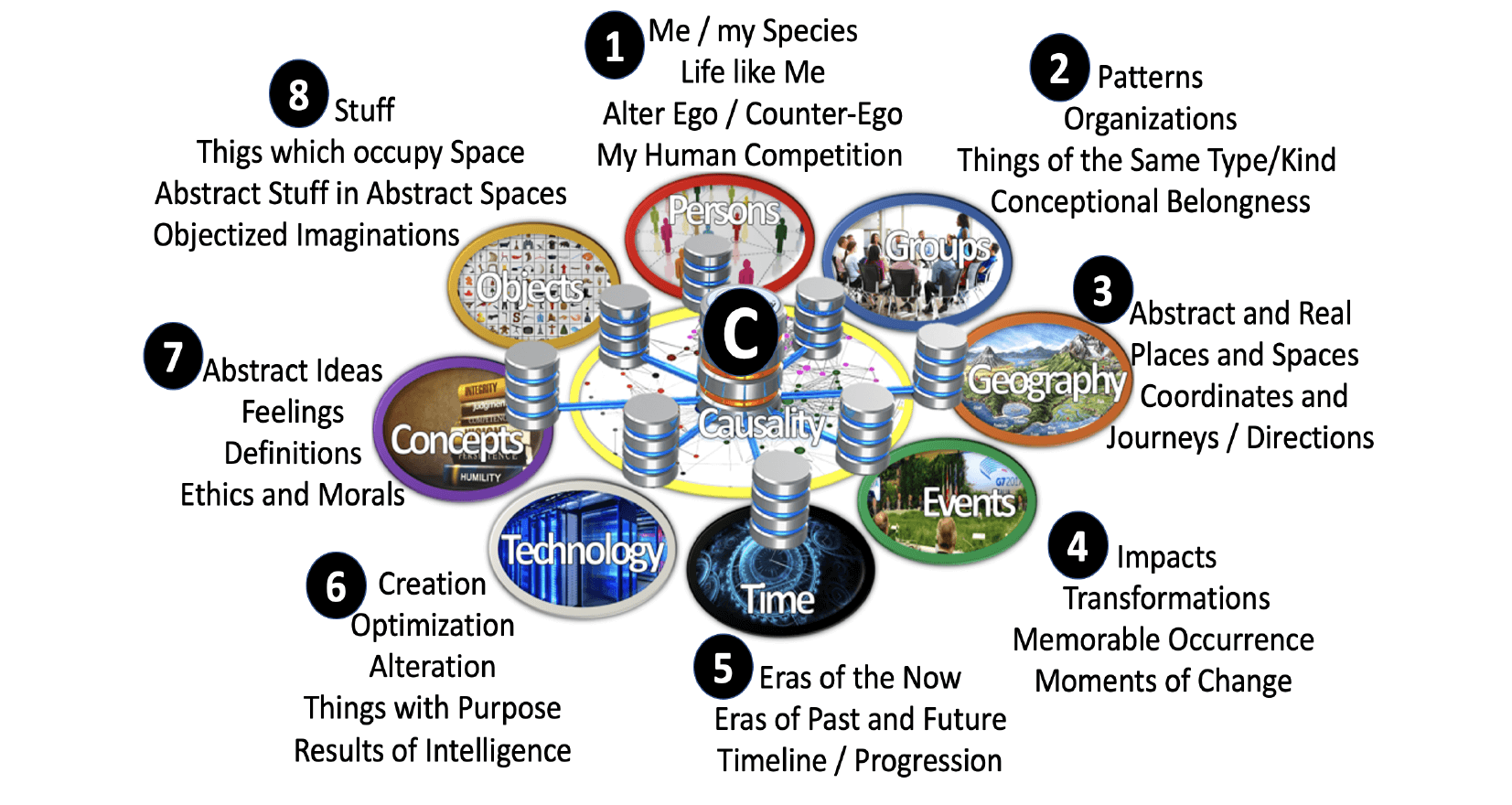
The analytical understanding of language media can be efficiently applied by QRI to historical and real-time data (in-stream analysis). It can be pre- and post-analysis filtered by sourcerelated and/or qualitative and associative parameters (for example, culture-centric, subjectcentric, POV-centric, conceptual-centric, event-centric, relationship-centric, etc.). QRI organizes the continuous stream of language effectively through a proprietary ontological system, which focuses in its center on any causal relationships (Causality) found in language between the eight cardinal cognitive entities of human understanding (see diagram below)


Essentially, QRI replicates ontologically and epistemologically how the human brain functions and processes information. However, it can do so without the typical limitations of the brain (for example, parallel learning, correctly remembering the sequential order of facts, remembering all history without distortion, preserving all quantitative, qualitative, and associative memory features, cross-domain contextual processing, etc.)

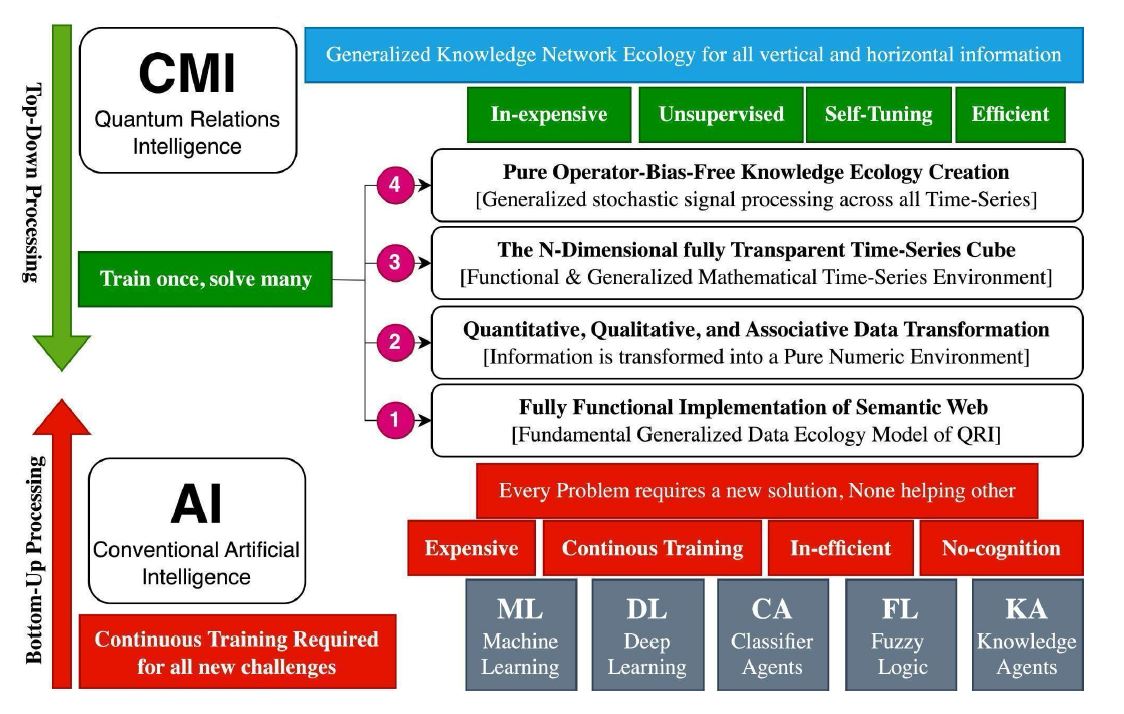
QRI can provide on an application level many features, which allow the solving of many intractable problems with traditional neural-net and machine-learning-centric AI systems, as the following diagram illustrates:

Commercial Implications of QRI

The commercial implications of QRI are groundbreaking, reshaping how the world operates and innovates. Imagine a system that processes vast amounts of data at lightning speed and learns and evolves through this data autonomously. QRI in government intelligence is profound, enhancing national security and strategic decision-making. QRI can analyze vast amounts of data from multiple vertical sources and domains, identifying patterns and potential threats that might go unnoticed by human analysts. This capability allows for more accurate and timely intelligence assessments, enabling proactive measures against security threats. In law enforcement, QRI is revolutionizing how agencies prevent and solve crimes. QRI policing algorithms analyze crime data to forecast potential evolving hotspots, allowing for more
strategic deployment of resources. QRI assists in investigations by analyzing digital evidence, identifying suspects, and predicting criminal behavior, leading to faster and more accurate case resolutions and fostering public trust in law enforcement agencies. QRI’s impact on news fact analysis is significant, combating the spread of misinformation and ensuring the credibility of information. QRI quickly scans and verifies facts across vast datasets, identifying false information and providing accurate context. This capability is crucial in today’s fast-paced news environment, where misinformation can spread rapidly. QRI also assists journalists by analyzing trends and providing insights, allowing them to focus on in-depth reporting. In power management and forecasting, QRI drives efficiency and sustainability by analyzing data from smart grids and weather forecasts to optimize energy distribution and consumption. This leads to more efficient resource use, reducing waste and lowering costs. QRI helps find energy
demand with high accuracy, helping to prevent blackouts and ensure a stable power supply. This benefits energy providers and contributes to environmental sustainability by promoting more efficient use of renewable energy sources. QRI can be effectively used in real-time marketing, consumer research, and social trend detection. QRI can aid fields of medicine, drug research, agriculture, logistics, energy, finance, cyber security, and any other area where real-time data interpretation is critical.

By integrating QRI, governments, businesses, and organizations can achieve greater efficiency, accuracy, and innovation, ultimately driving growth and success in an increasingly digital world.

Application Examples

QRI is transforming the public and private sectors by enhancing efficiency, accuracy, and innovation. From govt intelligence to retail personalization, QRI solutions are revolutionizing organizations and industries and improving overall service delivery. Here are some specific examples of how QRI is making a significant impact.

Public Sector:
Healthcare: QRI-driven diagnostic can accurately analyze medical images (like X-rays
and MRIs), helping doctors detect diseases early. This reduces diagnostic time and
improves patient outcomes.
● Public Safety: QRI-based surveillance systems can detect unusual behavior and
potential threats in real time, allowing law enforcement to respond quickly. QRI
policing algorithms can also forecast crime hotspots, improving resource allocation.
● Environmental Monitoring: QRI can analyze data from sensors and satellites to monitor
air and water quality, helping governments respond more effectively to pollution and
environmental hazards.
● Threat Detection: QRI analyzes vast datasets from various sources to identify potential
security threats, enabling proactive measures and rapid response to national security
issues.
● Surveillance: QRI-powered facial recognition and behavior analysis enhance
surveillance capabilities, aiding in identifying and tracking suspects in real time.

Private Sector
● Retail: QRI-driven recommendation systems can offer personalized product
suggestions, improving customer satisfaction and boosting sales. QRI can also optimize
inventory management by predicting demand trends reducing waste and stockouts.
● Smart Grids: QRI optimizes energy distribution by analyzing real-time data from smart
grids, reducing energy loss and ensuring efficient power delivery.
● Predictive Maintenance: QRI predicts equipment failures in power plants, allowing for
timely maintenance and reducing downtime, enhancing overall grid reliability.
● Renewable Integration: QRI predicts renewable energy production (e.g., solar, wind)
by analyzing weather patterns, facilitating better integration of renewable sources into
the energy grid.
● Marketing: QRI can analyze consumer data to create highly targeted marketing
campaigns, increasing conversion rates and ROI. Natural language processing (NLP)
can also analyze customer feedback and improve product offerings.

These applications demonstrate the transformative potential of QRI in enhancing efficiency, accuracy, and innovation across various sectors.

Publicat pe

Eveniment dedicat Inteligenței Artificiale. IA-QRI, rivalul creierului uman

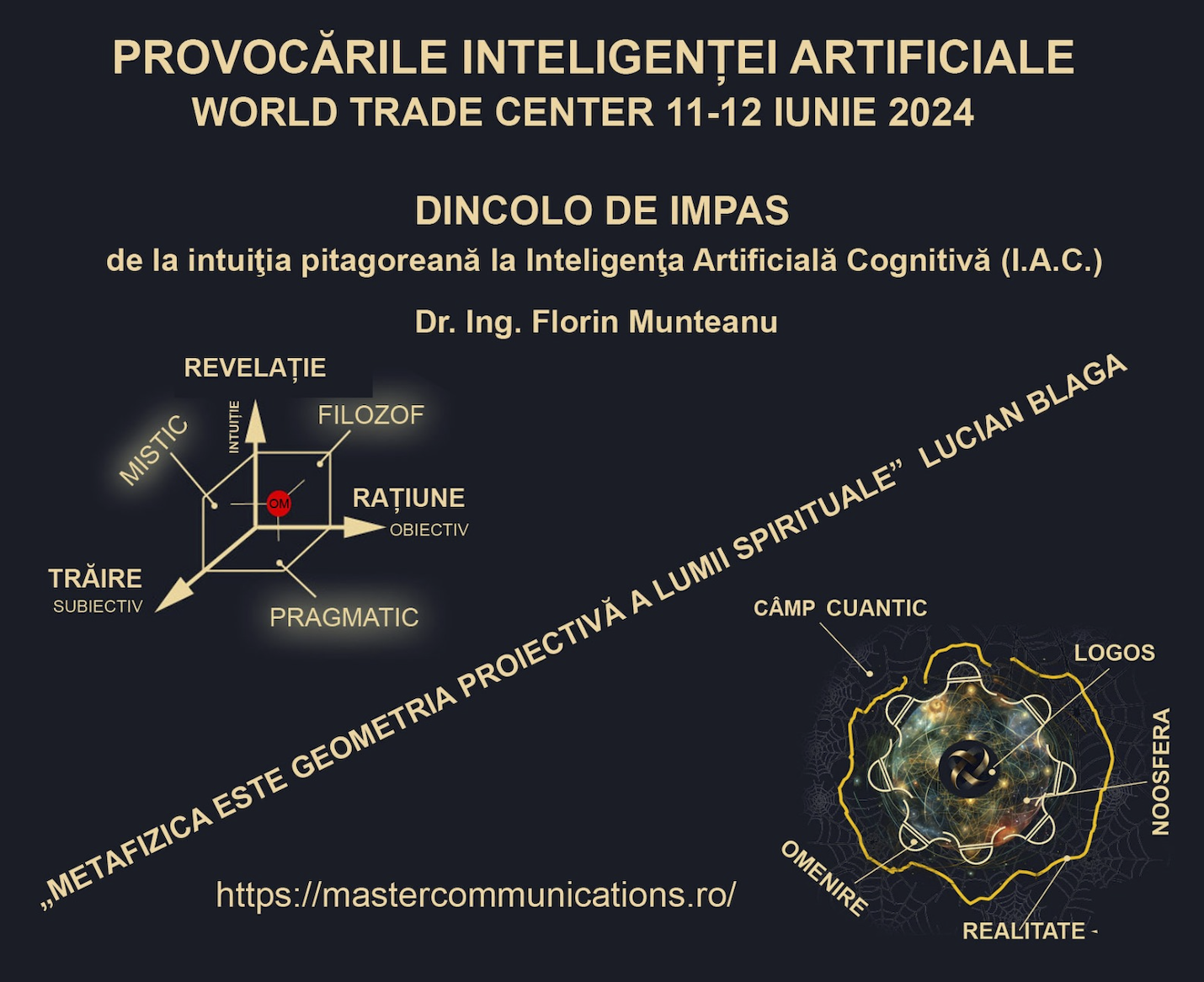
Pe 11-12 iunie, Master Communications Intl organizează, sub egida Academiei Europene, la World Trade Center (WTC), o conferință intitulată „Provocarea IA”. Acest eveniment promite să fie cel mai important și spectaculos din domeniul inteligenței artificiale.

Eveniment de excepție ce va reuni personalități de renume, printre care Președintele Academiei Române, miniștri, oameni de știință, lideri de afaceri cu realizări în domeniu, reprezentanți ai marilor companii și personalități din viața publică și presă. Invitatul principal este dr. Hardy Schloer, pionier în cloud computing, creator al Dow Jones News Analytics și al Cognitive AI (QRI), următorul nivel în inteligența artificială.

Hardy Schloer este un expert în tehnologie și inovator cunoscut pentru contribuțiile sale semnificative în domeniul inteligenței artificiale, cloud computing și analizele de știri financiare. Printre realizările sale notabile se numără:

Cloud Computing. Schloer este recunoscut ca unul dintre pionierii conceptului de cloud computing, o tehnologie care a revoluționat modul în care datele sunt stocate și gestionate, permițând accesul la resurse de calcul și stocare de date prin internet.

Citeste articolul integral pe EVZ.ro

Publicat pe

Dincolo de impas – de la intuiția pitagoreană a Inteligența Artificială Cognitivă (I.A.C.)

Deschide Mintea și dezvoltă Cunoașterea dacă vrei să utilizezi Inteligența Artificială Cognitivă. Utilizeaz-o pentru a rafina cele cunoscute și a căuta conexiuni noi între modele și teorii, între cuvinte, noțiuni și concepte.

I.A.C. este o “unealtă” esențială în Înțelegerea unei Realități structural-fenomenologice, duale, spațio-temporale, energo-materiale din perspectiva unei viziuni coerente, transdisciplinare. Alături de Calculatorul Cuantic, I.A.C. forțează limitele paradigmei actuale fiind astfel o provocare reală a Omenirii, blocată într-o gândire liniară, mecanicistă, utilitaristă, cantitativă.

Ca orice nouă unealtă are nevoie de un “caiet tehnic” în care să fie prezentate, clar şi coerent: – domeniul de utilizare, – modul de utilizare, – limitele și mai ales – pericolele unei utilizări incorecte. Problema este că acest caiet tehnic nu este încă structurat ci se afla într-o fază embrionară. Este şi motivul pentru care asistăm azi la dezbateri şi dispute în jurul temei: Inteligenta Artificială, pericol sau oportunitate. Evenimentul “Provocările Inteligenței Artificiale” este parte din acest efort internațional de analiză şi punere în discuție a subiectului şi explorarea acestuia din perspective diferite, astfel încât să fie clare domeniile şi limitele de utilizare.

Intervenția mea în cadrul acestui eveniment este centrată pe explorarea I.A. şi I.A.C din perspectiva utilizatorului, a cercetătorului implicat în crearea unui cadru conceptual transdisciplinar, capabil să identifice cauzele şi să genereze soluții pentru rezolvarea crizelor multiple cu care se confruntă azi omenirea. Nevoia acestui nou cadru teoretic, în conceptualizare căruia I.A. şi I.A.C. îşi dovedesc utilitatea, a fost evidențiată de Einstein prin afirmația: “ Nu putem rezolva problemele folosind același ip de gândire pe care l-am folosit atunci când le-am creat.”. Altfel spus, depăşirea acestui moment critic planetar, a acestui IMPAS este condiționată de naşterea unei noi viziuni asupra Realității în care Omenirea este organic legată de evoluția planetei Pământ (modelul GAIA), generatoarea Noosferei şi – responsabilă de geostazia/georezia planetară. Iar acestă viziune implică în esență un salt de Conştiință la nivel planetar. Adevărata valoare a I.A. şi mai ales a I.A.C. este de a ajuta Omul în a aborda această tematică complexă, cu implicații filozofice fundamentale în formularea cadrului teoretic din perspectiva căruia să găsim soluții care să ne ducă … dincolo de IMPAS.

Miza acestui salt? Supraviețuirea speciei şi conservarea Vieții pe Terra.

IMPAS = Situație încurcată, fără o soluționare convenabilă. 2. (Rar) Fundătură, ulicioară (drum) fără ieşire.

Dr. Ing. Florin Munteanu

Publicat pe

Artificial Intelligence and its management of businesses such as insurance, banking, health care, local and global commerce, sales and marketing, finance, and stock exchanges

Artificial Intelligence (AI) is revolutionizing various industries by enhancing efficiency, accuracy, and decision-making processes. This essay explores how specific types of AI can manage businesses in insurance, banking, healthcare, local and global commerce, sales and marketing, finance, and stock exchanges, showcasing the transformative potential of AI in these sectors.

In the insurance industry, AI is leveraged to improve customer service, risk assessment, and fraud detection. Machine learning algorithms analyze vast amounts of data to identify patterns and predict potential risks, enabling insurers to offer personalized policies and pricing. For instance, AI can assess driving behavior using telematics data to tailor auto insurance premiums. Natural Language Processing (NLP) enhances customer service through chatbots, which handle claims processing and answer customer inquiries, reducing response times and operational costs. Additionally, AI-driven fraud detection systems analyze claims data to identify anomalies and flag suspicious activities, mitigating the risk of fraudulent claims.

AI is transforming banking by enhancing customer experience, streamlining operations, and improving security. Robotic Process Automation (RPA) automates repetitive tasks such as data entry, compliance checks, and transaction processing, significantly reducing human error and operational costs. Predictive analytics helps banks identify customer needs and offer personalized financial products and services. For example, AI can analyze spending patterns to recommend savings plans or investment opportunities. Machine learning algorithms detect fraudulent transactions in real-time, safeguarding customers and banks from potential threats. Furthermore, AI-powered chatbots provide 24/7 customer support, answering queries and assisting with transactions, thereby enhancing customer satisfaction.

In healthcare, AI aids in diagnosis, treatment planning, and administrative tasks. Deep learning algorithms analyze medical images, such as X-rays and MRIs, to detect diseases like cancer at early stages with high accuracy. Predictive analytics enables personalized treatment plans by analyzing patient data and predicting potential health issues. Natural Language Processing (NLP) assists in managing patient records, extracting relevant information from unstructured data, and automating documentation processes. AI-driven chatbots and virtual health assistants provide preliminary diagnoses and health advice, improving access to healthcare and reducing the burden on medical professionals. Additionally, AI helps drug discovery by analyzing biological data and predicting how new drugs will interact with the human body.

AI optimizes operations, enhances customer experience, and drives innovation in local and global commerce. Supply chain management benefits from AI’s ability to predict demand, optimize inventory, and reduce logistics costs through route optimization and real-time tracking. Recommendation systems, powered by machine learning, personalize the shopping experience by suggesting products based on customer preferences and browsing history. Chatbots and virtual assistants improve customer service by providing instant responses to inquiries and assisting with order processing. In global commerce, AI-driven analytics help businesses understand market trends, consumer behavior, and competitive dynamics, enabling informed decision-making and strategic planning.

In sales and marketing, AI enhances customer targeting, campaign effectiveness, and sales forecasting. Predictive analytics identifies potential leads and segments customers based on their behavior and preferences, allowing for more effective targeting. Machine learning algorithms analyze data from marketing campaigns to determine which strategies are most effective, optimizing ad spend and improving ROI. Natural Language Processing (NLP) enables sentiment analysis, helping businesses understand customer feedback and adjust their strategies accordingly. AI-driven chatbots engage with customers on websites and social media platforms, providing product information, and guiding them through the sales funnel. Additionally, AI-powered CRM systems streamline sales processes and improve customer relationship management by automating tasks such as follow-ups and data entry.

AI plays a crucial role in financial management by enhancing decision-making, risk assessment, and compliance. Algorithmic trading uses AI to analyze market data and execute trades at optimal times, maximizing profits and minimizing risks. Robo-advisors, powered by machine learning, provide personalized investment advice based on individual financial goals and risk tolerance. Predictive analytics helps financial institutions assess credit risk by analyzing borrower data and predicting the likelihood of default. Natural Language Processing (NLP) assists in regulatory compliance by automating the analysis of legal documents and ensuring adherence to complex regulations. Furthermore, AI-driven financial planning tools help individuals and businesses manage their finances by providing insights into spending patterns and future financial needs.

AI enhances the efficiency, security, and profitability of stock exchanges. High-frequency trading (HFT) algorithms use AI to execute trades at lightning speeds, taking advantage of minute price discrepancies to generate profits. Predictive analytics helps traders anticipate market movements by analyzing historical data and identifying trends. Machine learning models assess the impact of various factors, such as economic indicators and geopolitical events, on stock prices, enabling more informed trading decisions. Natural Language Processing (NLP) processes news articles, social media posts, and financial reports to gauge market sentiment and predict stock movements. Additionally, AI-driven surveillance systems monitor trading activities in real-time to detect and prevent market manipulation and insider trading.

Artificial Intelligence is a powerful tool that is transforming industries by enhancing efficiency, accuracy, and decision-making. In insurance, AI improves risk assessment and fraud detection. In banking, it enhances customer experience and security. In healthcare, AI aids in diagnosis and treatment planning. In commerce, it optimizes supply chain management and personalizes customer experiences. In sales and marketing, AI enhances targeting and campaign effectiveness. In finance, it improves decision-making and compliance. In stock exchanges, AI boosts trading efficiency and security. As AI technologies continue to evolve, their impact on these industries will only grow, driving innovation and delivering substantial benefits.

Publicat pe

Some applications of AI

AI can add many features and benefits to energy, healthcare, finance, banking, advertising, social media, and fake news detection. Here are some examples:

Energy Efficiency:
AI can optimize energy usage by analyzing patterns and predicting demand, leading to more efficient distribution and reduced waste.It can also enhance predictive maintenance of energy infrastructure, reducing downtime and improving reliability.AI-powered systems can optimize renewable energy production by predicting weather patterns and adjusting energy generation accordingly.

Improved Healthcare Quality:
AI can assist in medical diagnosis by analyzing medical images, genomic data, and patient records, leading to more accurate and timely diagnoses. AI can significantly improve patient outcomes through personalized treatment plans based on individual health data and predictive analytics.AI-driven virtual health assistants support patients, offering guidance on managing chronic conditions and medication adherence. AI significantly reduces malpractice in clinical environments.

Supporting Finance and Banking:
AI-powered algorithms can analyze vast amounts of financial data to detect fraud and anomalies in realtime, enhancing security. AI can automate routine tasks such as loan approvals, customer service inquiries, and risk assessment, improving operational efficiency and quality control in this way.AIchatbots and virtual assistants can enhance customer experience by providing personalized financial advice and support.

Optimization in Advertising:
AI can analyze consumer behavior and preferences to deliver targeted advertisements, improving ad relevance and effectiveness.It can also optimize ad placement and bidding strategies in real-time, maximizing advertisers’ return on investment.AI tools can analyze campaign performance and provide insights for optimizing future advertising strategies.

Managing Social Media:
AI can analyze social media content to identify trends, sentiments, and influential users, enabling targeted marketing campaigns. AI automates content moderation by potentially detecting and removing inappropriate or harmful content, enhancing platform safety.AI-based recommendation systems can personalize user experiences by suggesting relevant content, products, or connections.

Detection of Fake News:
AI can analyze news articles, social media posts, and online content to identify misinformation and fake news.Natural language processing (NLP) techniques can detect inconsistencies, biases, and unreliable sources, helping users distinguish between credible and unreliable information.AI-driven fact-checking tools can provide real-time verification of news stories, reducing the spread of misinformation.

Publicat pe

Artificial Intelligence – Utopia or Dystopia

The Rising of Transnational Superpowers: Hidden Forces without State Identity, Transparency, Accountability, Ethics, Social Responsibility or Democratic Mandates

by Hardy F. Schloer

Advancing in an era of increasingly armed conflicts and geopolitical tension between many nations and cultures has consequently focused increased attention on border security and national territorial and cultural integrity within nations. Nevertheless, even in more peaceful times, nations would not likely welcome others to invade their borders, rule or profoundly influence their citizens, especially against their interests, and take control of commercial, economic, social, or political processes, regardless of which means and forms they became imposed. Such activity would likely be considered an act of confrontation or at least viewed as antagonistic meddling in a country’s integrity, security, and national affairs. It is, therefore, nothing less than astonishing how a relatively new rising force in the form of pervasive Artificial Intelligence has become such an obscure entity of possibly even greater power than conventional armies or police forces any nation-state could presently muster.

Artificial Intelligence as transnational societal influence and power

The problem is complex. Artificial Intelligence, or short AI, primarily when operating as an economic or societal influence, is by nature elusive, invisible, virtual, without physical properties or appearance, yet its pervasive effects are everywhere. AI is now quickly becoming integrated into any aspect of our daily life. AI has become omnipresent. It is also most influential in that AI begins to control information, actions, responses, conclusions, opinions, emotions, and voluntary or involuntary decisions on all levels of society, economically, socially, and politically. What poses an even greater risk to society is that this invisible force can now be deployed by anyone capable of operating a computer, writing programming code, and accessing reasonably powerful server hardware connected to the global Internet. One can deploy such powerful AI tools from anywhere in the world and target any audience of any profile, geography, culture, or demographic, and apply any economic, social, or political focus to direct its often opaque and none-transparent purpose to manipulate and gain economic, social, or political leverage. This artificially intelligent force never sleeps, operates around the clock at the breathtaking speed of light, is parallel in force and application, and is fully scalable in pursuing its given goals. AI is now operating far beyond the horizon of human cognitive abilities to manage or curtail its pervasiveness.

However, to understand this article correctly, we must first differentiate between various types of AI applications and their purposes. There are genuinely great benefits when AI is used to assist in very clearly defined, specific, and transparent processes of our day-to-day lives. For example, AI creates vital knowledge to aid education, decision support, security applications, and complex forms of scientific data analysis, such as predicting long-term weather patterns for farming or when applied in computerized heart surgery in hospitals. Other examples are AI-powered robotics in the precision assembly of technical products such as computer chips and micro-technologies 3-D printing. AI-enabled decision support can successfully automate the autonomous trading of financial securities. Enormous quantities of research data can be used to build a complex information matrix, for instance, to predict climate-change models or to evaluate potential multi-contextual risks for the future. Self-driving cars are another great AI application, and these real-time AI programs can bring great convenience to our day-to-day lives.

AI can genuinely help, when applied correctly, to make much better decisions on a societal level. These applications have much room for improvement, as they all operate very fragmented and disconnectedly. However, this is an easily solvable problem. We can learn to utilize AI in future applications globally and within a common transparent data and analytics standard. This practice would allow the creation of a global information ecology, which can benefit all applied AI equally across all fields and all human activity applications.

Nevertheless, the AI we are critiquing in this article is not the utilitarian and universally beneficial use of such applications for convenience or management of processes, as described in the last paragraphs. We would like to focus on the many hidden tools of powerful, economic, social, and political AI-generated influence that give rise to unprecedented transnational powers over whole societies in all shapes and forms.

Let’s look at these three forms of influence individually, as they pose big questions about how AI shapes society and security for humanity’s collective future.

First: AI for Commercial and Economic Exploitation

Motivated by economic gains, most commercial operators now unleash increasingly powerful AI technologies to capture potential consumers with financial resources, large or small, to order, accept, buy, or subscribe to their commercial offerings. The engagement through these sophisticated technologies is now becoming one-sided and heavily tilted in favor of commercial interests. This powerful coercion is beginning to blur the borders between economic corruption and legal opportunity. Let us be clear: It is all about convincingly framing the narrative and acceptance of products and services, their information, and descriptions, and in this way, to seduce and vigorously promote favorable economic behavior by targeted consumers.

Most of us will call this fair game and clever marketing. Nevertheless, the fact remains that AI-based applications can very successfully create, manipulate, frame, control, time, distribute, and filter information in any legit or legit way required to archive any desired effects and economic behavior to profitably capture the financial resources from consumers, at the highest speed, bandwidth, efficiency, and for the lowest cost and risk exposure possible. Such a form of AI knows no morality or ethics, only given goals and targets.

Just like in a gambling casino, where the casino operator has no qualms about seducing a gambler to wager away the food money for his children, AI-armed business operators can increasingly use any available powerful technology to achieve the same effect to inspire impulsive and unjustified spending, or accepting excessive debt. The goal is to sell as often and as much as any offer, regardless of how unnecessary or overpriced products or services may be to its buyers. Furthermore, in extreme cases, AI is increasingly used to defraud consumers skillfully. But not limited to deep-faking and imposter any legitimate product or service. Profits are the religion, and its ‘stairway to heaven’ is leading to the fast wealth of the AI weaponized commercial operator. It’s the onset of a new AI-powered gold rush.

This form of profiling and targeting consumers is neither new nor uncommon, as it has been a commercial practice since humanity invented money, trade, sales and marketing, and financial and commercial systems. To be clear, we have come to accept this as a standard practice of modern entrepreneurship, and we do not evaluate whether this is useful or moral in this article. However, what is new and frightening is that the human marketer no longer deals with a human buyer in a coherent and hopefully somewhat sensible human-to-human interaction. Until now, this practice was at least somewhat socially balanced. However, now consumers become engaged by powerful machines, which become optimized to use every possible artificially intelligent way to take any financial resources from any potential target that can be reached and engaged by the system, day and night, continuously, and anywhere, to the soul benefit of its operator.

These robust AI processes have lately become optimized to explore every single weakness of a potential consumer, including sometimes tricking him into a mistake of ordering, buying, subscribing, or accepting much more than he wants or can afford. The predatory proverbial ‘snake oil salesman’ of the 1800s is now, in this age of AI, armed with a powerful networked and scalable AI machinery that can find and reach any usable economic target on this planet; simultaneously, quantity, qualify and categorize the target for his economic potential and weaknesses, shape the perfect ‘message of seduction’ execute its scripted process of engagement, and let the computer simply pile up the monetary rewards for its operators.

In the past, this process was known as innovative advertising, clever sales tactics, and effective marketing. However, with the massively targeted use of potent and scalable AI technologies, what is shaping up now deserves a whole new terminology to fully describe this process appropriately.

It is often argued that good capitalism balances the economic playing field. This premise can be argued as being true or not. Nevertheless, a commercial system supercharged with robust AI programs to be unleashed onto targets and coerce consumers deserves a deep discussion amongst all market participants and probably a good look by regulators if current consumer protection laws sufficiently cover this emerging technology trend. In this context, we must also recognize the fast-spreading transnational applications of this new craft, where nations’ regulatory protections become useless to stave off consumer manipulation, fraud, and coercion from abroad. Online payment systems work globally, and these AI-powered coercive sales machines can easily exploit them to maximize the rewards for these AI-powered operators.

In this context, we can easily predict that widespread adoption of this practice will soon have measurable economic and societal effects, and likely negatively so, especially when excessive amounts of financial resources and the illegal fruits of coercion are shipped half around the globe into the pockets of AI technology-savvy operators, leaving in its wake to nations only the debt of its citizens amongst other adverse effects. Again, the lines between invasive and aggressive machine-aided business practice and actual full-scale fraud are blurring increasingly.

Some emerging operators no longer care about giving an appearance of legality when it comes to rising networks of AI-aided fraudulent financial and commercial activities. Good examples of this are already emerging locations of massive deployment of automated economic fraud, often originating from East and Southeast Asia and other such quickly evolving locations, including also lately from Sub-Sahara Africa and Eastern Europe where there are favorable conditions exist for such activity to support such actions either through widespread corruption or very lax levels of law enforcement, or the absents of any laws altogether to govern such new patterns of emerging economic crime.

These trans-border operators solicit victims on a massive scale, day and night, using the latest advancements in AI, such as entrapping interactive bots, deep-fake content, counterfeit applications, impersonations, and fully legit appearing but illicit copies of trusted commercial websites, amongst many other such examples. All this dramatically expands the borders, scope, meaning, and definitions of Cyber Security. 

Second: The Pandemic of Social Influencing

If the previous section raises concerns about how AI is used adversely on society, AI-aided social influencing is taking these concerns to a new level. Remembering that information drives human beliefs, emotions, feelings, reasonings, conclusions, associations, actions, and reactions is essential. AI can be used to make a machine understand the signatures and signs of these properties through machine pattern analysis. This technique is commonly called AI’ machine learning’, and it is used to capture language, individually and on a large scale, to extract valuable patterns for human influencing and manipulation. Machines armed with AI tools and networked to the Internet can be programmed to focus on specific types of individuals, groups, geographies, and property signatures of any other associative selections one would like to target with such an approach.

AI can explore efficiently and fully scalable communication mediums, such as blogs, social media, messenger texts, emails, etc. It becomes apparent that this powerful form of influencing and manipulation goes well beyond commercial exploitation and potentially drives the belief systems within society. This practice can target, through AI applications, any group within society that one wishes to manipulate, to believe a set of facts, behave in a particular way, or commit actions that otherwise would not have been considered.

Manipulation of the masses is not new. This practice has been done by influential demagogues for thousands of years, especially in the political arena and social communications. Nevertheless, these influencers had to appear on a stage, invite the masses, and speak to them openly, physically and verbally. They had to show their faces and became associated and responsible for the content they spoke. Modern emerging technologies such as radio and television in the early 1900s expanded the forum and platform for social influence and manipulation dramatically. Fascist leaders in Europe in the 1930s and 1940s made great use of radio broadcasts to push their manipulative agendas and influence the masses to go to war with each other. However, with the rise of the Internet in the mid-1990s, this practice became supercharged and depersonalized. Now, anyone can create influential content, publish it at virtually no cost, and say anything anonymously without risk of repercussions by often using pseudonyms and anonymous websites.

Modern search engines such as Google and Yahoo added formidable functionality by making content especially visible through search optimization techniques. Now, anyone can successfully publish any content in any language, targeting any part of society in any planet’s geography and from anywhere. For example, an individual in East Asia could now, from the comfort of his living room, create highly influential content in, let us say, German language, imposter as a German native, and publish such content on German websites, with ideas and concepts very favorable to enforce the agenda of the Asian publisher. Since there is no fact-checking on the Internet, anyone can allege anything without restrictions.

All this illicit practice was possible and practiced before AI came into play. The event of the Internet exposed a frightening decay of societal ethics and honesty in its general conduct and communications. However, with new emerging and quickly adopted language processing technologies such as AI-powered interactive bots, chatbots, and other available technologies such as ChatGPT, Gemini, and similarly AI-powered systems, this technology trend has now accelerated the delivery method for many special-interest groups to unleash on a massive-scale miss-information and dis-information to serve their purposes. This practice has become a sociological pandemic of astonishing proportions. The effects of this trend are perhaps best categorized as the psychological holocaust of global proportions. 

At the World Economic Forum in 2024 and several other significant think tanks in the US and Europe, misinformation and disinformation became identified as the number one existential threat to society ahead of nuclear war, climate change, and any other catastrophic events. Given that this trend is only in its early stages, we must begin to understand the severity of these psychological, sociological, and political impacts.

Given that in this unfolding trend, soon nobody can believe anything published anywhere by anyone, society will lose its ability to reliably communicate any vital facts without them being distorted, questioned, and corrupted in multiple ways. Anything published may be categorized as conspiracy theories, fake information, or disinformation since much of it will be. Therefore, society loses the ability to communicate or receive reliable information. Already today, many have doubts even about established simple facts of events, such as the landing on the moon in 1969 or the origins of the 9/11 attacks in New York in 2001, with many suspecting malicious government conspiracies.

In an emerging environment of justified distrust towards any information given by anyone, society will begin to choose the information that is not necessarily true but in concurrence with individual moral beliefs, fears, suspicions, and other adopted values. Such a trend will result sooner rather than later in the total erosion of inter-societal trust, all forms of information, and essential democratic functions. Soon, AI-technology created and delivered information content unleashed by illicit special interest groups will likely trigger further breakdown of society, with potential revolutions, panic, waves of hate crimes, anarchy, and heavy-handed police actions to counter societal breakdown and misconduct. Early signs of this trend can already be seen in North America and Europe, where internet-consumed conspiracy content through automated media platforms is consumed the most.     

Third: Geopolitical Corruption and State AI Warfare

The ultimate dystopian nightmare is best described in the nations’ governments’ widespread adoption of these above-described technologies and illicit behaviors to conduct geopolitical warfare. This practice includes AI-aided language processing, real-time interactive fake content delivery, and waves of targeted disinformation to create precipitous interference in another country’s population or a nation’s native population to justify questionable actions on international matters. One of the most common types of illicit behavior is the steep interference in other nation’s elections through computer-automated and targeted misinformation. Likewise, the same strategies become used to destabilize society, much to the advantage of a foreign interfering power. Unfortunately, the list of countries engaged in this type of problematic conflict is getting longer, including some of the most technologically advanced nations that have, by now, in one way or another, used targeted disinformation and misinformation as geopolitical warfare strategies: AI-aided language tools and the Internet as a delivery medium are typically used in nearly every case.  

In the previous two sections, we pointed out that organized and AI-aided economic exploitation and social influencing, which operate within society, erode trust in general commercial integrity and online information. The behavior described in the current section, however, erodes not only the trust in governments but also promotes deep animosity towards governments and promotes anarchy, rejection, social unrest, and, ultimately, revolution on a global scale. This changing mindset becomes extraordinarily clear when measuring the application of language and vocabulary across large sections of society over the past two decades. Humanity seems to be on its way to creating a deeply disturbing and dark Dystopia, aided by most modern tools of AI and related communication technologies.

Publicat pe

Artificial Intelligence – the Storm of Change


An Introduction to the Bucharest AI Conference 11th and 12th of June, 2024, by Hardy F. Schloer

There is no question, our modern day to day life has benefitted greatly from the broad adoption of the so-called Artificial Intelligence, for short, AI. Our life is changing currently in powerful ways we only can compare with the beginning of the Industrial Revolution. This time, however, it’s happening at near-light speed.  Life soon will never be the same. To highlight these facts, we can take a brief look at just two simple examples: agricultural farming and the field of healthcare. Here are some basic facts on how AI has transformed these two areas of society irreversibly:

Today AI has given rise to Precision Farming, which can accurately monitor soil health, degradation, and irrigation. AI is incorporating in farming strategies such technical features as real-time precision meteorological predictions, plant breeding optimization, computer-based crop advisory, plant disease detection, or deploy automated drones for precision spraying of pesticides. From an economic perspective, AI can now manage mapping yield with market demand. Farmers can now use agricultural robotics together with AI-generated predictive analytics and automation in production, weeding, and assisting in any other type of farm-based decision-making. The old romantic idea of a farmer is quickly giving way to the AI farmer, armed with super-computers and networked technologies. This trend is not only greatly accelerating, but it is irreversible. Those farmers without AI will soon be rendered uncompetitive and soon irrelevant. The farmer of the future is a robot.

Just like farming, the field of medicine is equally transformed in many ways. Pharma companies for example use AI aggressively now in precision medicine creation (one drug for one person), and they can do clinical trials simulations and therefore accelerate greatly new drug discovery. In the clinical practice of medicine, AI-based analysis of medical images such as Skin Vision in Dermatology or x-ray interpretation is integrated already everywhere in modern hospitals. There are many other AI applications in medicine such as autonomous patient health monitoring, robot-assisted surgery, digital consultation, treatment plan designs, virtual healthcare assistants, virtual nurses, dosage error reduction, quality control in patient interviews, and telemedicine to monitor patients 24/7 remotely. In administrative tasks, AI can manage autonomously administrative workflows, create, and preserve medical documentation, implement universal quality control in health data, and manage cybersecurity for medical patient information. And all this is only the beginning.  The doctor is becoming gradually the administrator of robotic technological tools, and no longer the caregiver or decision maker. This may sound like a Science Fiction movie, but this time, its reality, and it is well on its way to transform the entire field of medicine. The human factor is gradually eliminated from the equations of clinical decision making and caregiving, and the design, implementation, and monitoring of treatment plans.

The two examples above barely touch the full scope and power of this AI storm we are about to experience. Not all effects are positive and desirable. Many negative consequences are arising from the AI transformation as well. For starters, all these AI solutions are created as one-solution-for-one-problem approach. None talk to others, none help others. Some AI problem solutions may contradict other ones, and therefore pinning one AI against another, often without realizing it (i.e. production vs. environment, etc.). Moreover, AI is unfortunately not used only by those who have good intentions, but it has already become increasingly a primary tool for criminals, crime organizations, rogue government entities, and ill-applied social media interactions (i.e. deep-fake, miss and dis-information, illicit trade, etc.). The negative effects of this AI adaptation have already begun to outpace in some areas the positive benefits. To make things worse, this very broad and thorough adaptation of current AI models (i.e. generative AI, Neural Nets, Machine Learning, etc.) are predicted by at least six different major scientific university studies from the USA and elsewhere, to consume by 2028-2035 more electricity than the rest of the entire planet combined. This is neither sustainable, nor currently even possible, given the physical and environmental limitations of electric power production with present technologies within an environment which is already at a most critical phase, posing an existential threat to humanity and the global bio-ecology.

All this is only the initial starting point for the discussions of this conference, in which we look critically at these problems, opportunities and potential solutions, and to re-frame the entire field of Artificial Intelligence, for it not to become the existential threat and possible end of humanity, but a true beneficial advancement for a sustainable, safe, and desirable future. We will illuminate several very necessary transformations and their related possibilities. First, the immense dominance and powerful consequences of modern AI should not be viewed as an isolated special interest solution, but must be consensually acceptable by humanity at large, and globally, as they affect every man, woman, and child on this planet eventually. This requires a global top-down approach of the application of AI across every aspect of humanity.  AI must not only affect, enable, change, and solve things, but it must do so within the global framework of transparently knowing and understanding all consequences of such actions; short-term and long-term.  This can only be done by creating an information-ecologic and global top-down inter-connected AI environment, within all AI solutions that can be tested and implemented in its contextual and consequential matrix of global behavior and balance amongst all global stakeholders. What is truly needed is a global cognitive AI approach (AI modeled around the way humans think, not the way machines think) and a technological framework, which enables humanity to adapt AI safely, effectively, and transparently, taking security, equality, and ethical values into consideration.

This conference is organized to present and discuss the much-needed changes and solutions by creating a desirable and safe future where our life becomes of better quality through future AI, by solving the critical problems of current AI.